GAMWIT · Predict. Personalize. Visualize

Responsible Gaming

GAMWIT's Responsible Gaming model flags players whose behavior shows early signs of gambling harm, so your responsible gaming team can step in while it still helps.

Harm risk, per playerRefreshed on every run

Player Risk

  • #100036HighReview today
  • #100044MediumSoft intervention
  • #100024LowWatch
  • #100052No riskClear

Example rows, not live data shape as in the GAMWIT platform

Why responsible gaming matters

Responsible gaming failures lead to real fines and real harm.

Depending on the market, it can mean multi-million fines or a lost license. GAMWIT's Responsible Gaming model flags players showing signs of risk, so your team can review them early.

See what your team gets
  • £17M

    fine for a major UK operator in 2022 over social responsibility failures.

  • $14B

    estimated yearly social cost of problem gambling in the US (Dec 2023).

  • 2.5M

    US adults, about 1% of the population, live with a severe gambling problem.

Source: figures as cited on GAMWIT's Responsible Gaming model page.

What GAMWIT shows your compliance team

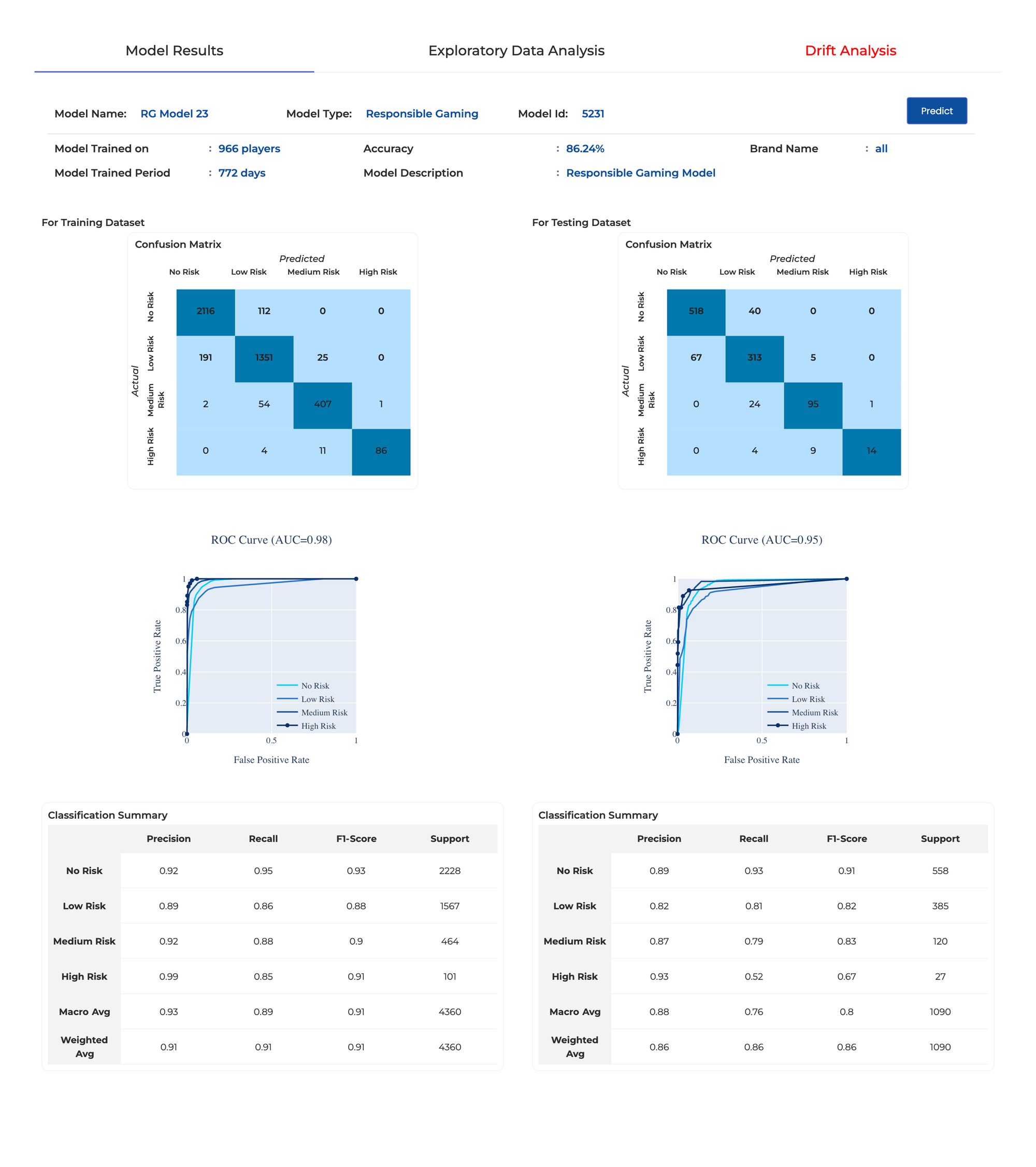
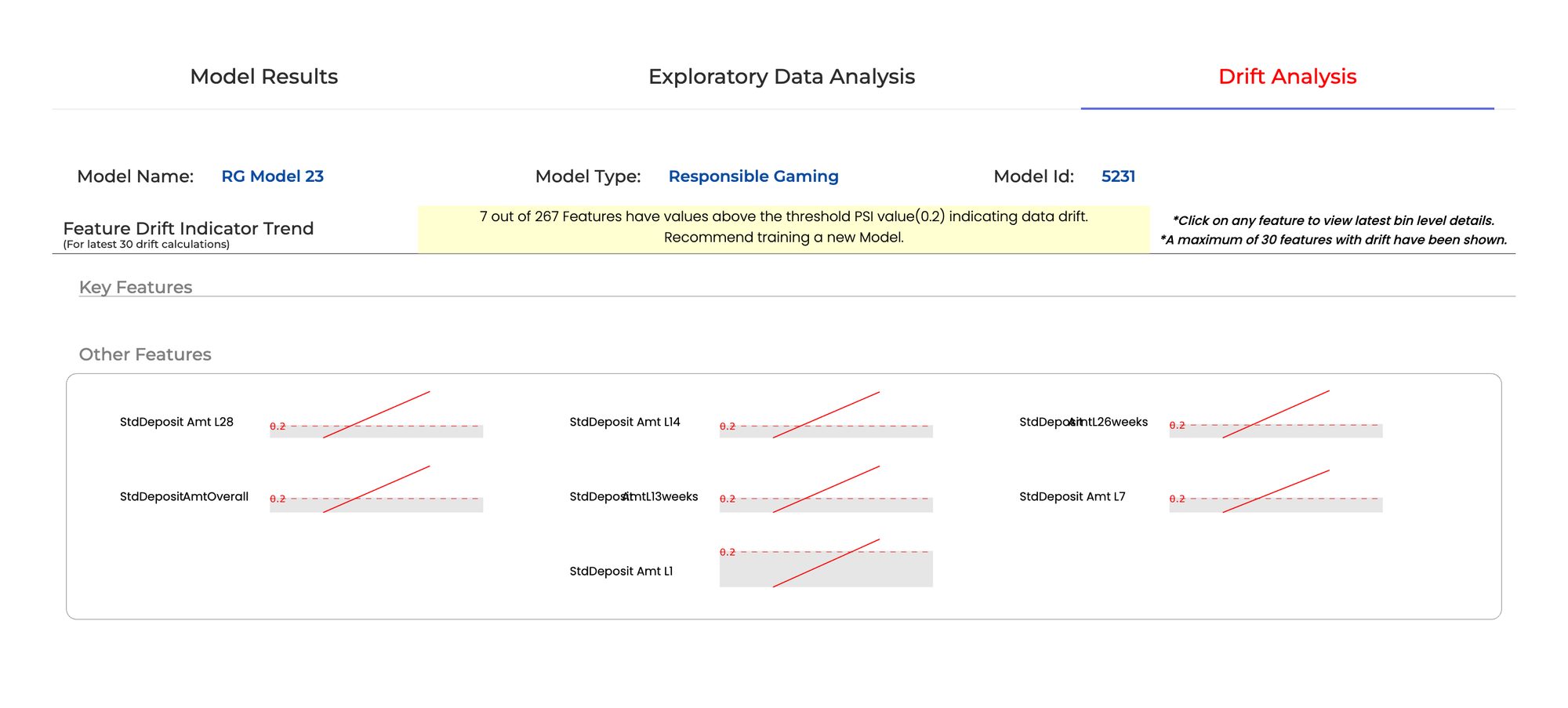
Two screens from a licensed GAMWIT account. The first is how the model is validated. The second is how it tells you when it needs retraining.

Full Model Results panel for the Responsible Gaming model: confusion matrices, ROC curves and classification summary with precision, recall and F1 per risk class

Validation, per risk class

How often the model was right for each risk class, No, Low, Medium and High, on the players it learned from and on players it had never seen. The team can see where it is strong and where it is cautious.

Validated on players it had never seen. Sample data.

GAMWIT Drift Analysis screen: banner reading 7 out of 267 features have values above the threshold PSI value 0.2 indicating data drift, recommend training a new model, with sparklines per feature

Drift, flagged when the data changes

The model watches 267 signals in player behavior. When enough of them drift from what it learned on, the screen says so and recommends retraining.

Live screen. 7 of 267 signals drifting on this model.

These are sample players. In a walkthrough, we run the Responsible Gaming model on yours.

Book a walkthrough

What changes

What changes when GAMWIT watches every player, every day

The decision stays with your team. What changes is how early, and how consistently, they see the players who need a look.

How risk is spotted

Without GAMWITA trained team member notices something, if they are looking at that account.

With GAMWITGAMWIT monitors behavior across every player, continuously.

When it surfaces

Without GAMWITOnce harm is visible enough to be obvious.

With GAMWITEarly, when the signs are still subtle.

Coverage

Without GAMWITSampled and manual, so it depends on workload that week.

With GAMWITEvery player, every run, the same way.

What happens next

Without GAMWITIntervention is decided ad hoc, often after a complaint or a large loss.

With GAMWITYour team decides, from a flagged list, using the tools you already run.

How it works

How GAMWIT supports the process

Why early identification is difficult

  • The behaviors are not uniform

    Frequent and intense sessions, chasing losses and emotional distress are common indicators, but not every affected player shows the same ones.

  • People hide it, or do not see it

    Many go to considerable lengths to avoid being blocked or restricted, and others do not recognize the problem as one, so they never raise it.

  • The data is partial

    Operators often lack the detail that would reveal the pattern, and interpreting what they do have is slow, specialist work.

  • Regulation limits monitoring

    Privacy rules, rightly, limit how much player data can be collected and watched.

  • Manual review depends on training

    Spotting the signs needs experienced eyes, so coverage varies with how well and how recently a team was trained.

  1. Early warning

    The Responsible Gaming model reads the behavior patterns linked to harm and flags them while a light-touch intervention is still enough.

  2. GAMWIT fits the tools you already run

    Self-exclusion, time limits, deposit caps, reality checks, cooling-off periods and gameplay reminders stay yours. GAMWIT tells you sooner who might need one.

  3. Consistency across the whole base

    GAMWIT reads every player the same way, which a manual review cannot do across thousands of players.

GAMWIT supports your responsible gaming process. It does not diagnose a player, it does not make the intervention decision, and it is not a substitute for your regulatory obligations or your trained team's judgment.

In practice

How teams use the Responsible Gaming model

Examples from GAMWIT's use-case guide. They show how the model is used, not a customer's results.

Chasing losses

The situation

A player loses a deposit, immediately deposits double, loses again, then deposits four times as much.

What GAMWIT does

GAMWIT places the player in the High risk class. Your team decides whether a deposit limit is suggested or applied.

Late-night play

The situation

A usually casual player starts playing aggressively at 3 AM on weeknights.

What GAMWIT does

GAMWIT flags the change in behavior. A welfare message goes out with the tools to play responsibly, from your team, in your words.

Ten declined cards

The situation

A player tries to deposit ten times with different declined cards.

What GAMWIT does

GAMWIT surfaces the signs of financial distress. The account is paused for review before debt accumulates.

How to use the results

  • Soft intervention: session reminders, cool-off periods, deposit limits and self-exclusion options offered to at-risk players.
  • Hard intervention: high-risk players flagged to the responsible gaming team for a welfare call.
  • Marketing suppression: high-risk players removed from promotional lists automatically.
  • Interventions and promotional restrictions scaled to the four risk classes.

Quick winScrub marketing lists against the high-risk list every day.

Try it yourself

Start a free trial. See your first predictions in about 15 minutes.

Sign up and build your first model yourself, no setup call needed. Prefer a guided tour? Book a walkthrough instead.

Getting started

What you need to get started

The Responsible Gaming model at a glance

What you get
A flag per player (classification)
Predicts
A player's risk of problematic or harmful play
Output
No, Low, Medium and High risk, per player
Data it reads
Self-exclusion flag, time on site, session activity, betting activity, NGR, GGR, deposits, and withdrawals in every status including failed and cancelled
History needed
180 days to start. 1.5 years kept for model stability.
Package
Add-on

What it asks of your team

  • No data science team

    Marketing, Finance, Risk and Compliance teams use it directly, without an analytics background.

  • Works with your data as it is

    Wherever and however your gaming data is stored, the GAMWIT team handles the connection. See how GAMWIT connects

  • Runs on its own

    Once connected, the model runs on its own and delivers fresh predictions on every run.

Recognized by the industry.

  • FinalistCompliance Innovator of the YearVixio · 2024
  • NominatedCompliance Technology ProviderEGR North America · 2024
  • NominatedData and AI PartnerEGR B2B · 2022 · 2023

Run GAMWIT's Responsible Gaming on your own players.

The Responsible Gaming model is already built. Connecting your data takes 2 to 4 weeks.